
Tree Risk Assessment and Cabling in Mishawaka, IN
Mishawaka Local Tree Service looks over trees that worry their owners in Mishawaka, IN, and says whether each one wants pruning, a cable, a removal or nothing yet. First we sort out whose it is. A maple growing in the strip along the curb answers to city rules, while anything on the house side of the walk is yours to decide about. We also check trees in Granger, Osceola, Simonton Lake, Elkhart, Edwardsburg and Bremen.
Request a quote
Give us your street and what worries you about the tree. We will call you back.
Generally, an assessment is there to understand the scope of work. It's quite cheap, only $100 to $250, and it could save you time later on. If a crew comes with general equipment and it does not fit the tree, they need to come again, so you pay twice.
- Whose tree it is, settled before any price
- Trunk sounded by mallet on every side
- Cables only on a fork that is still sound
- Prune, cable, watch or remove, ranked by urgency
- Steel or dynamic cable, upkeep explained
Estimate an assessment or cabling bill
Typical prices per tree for Mishawaka jobs. Your quote follows a look at the job.
$200 to $500
Call (574) 227-6183 for your priceAt a glance
| Risk assessment | Between $100 and $250 per trunk looked at |
|---|---|
| Written report | One trunk $150 to $450; a group $300 to $700 |
| Cabling | $200 to $350 per tree, hardware in |
| Assessment levels | Level 1 walk-by; Level 2 full look on foot; Level 3 aerial or decay testing |
| Dynamic cables | Checked twice a year |
| Silver maple | About 1 in 4 Mishawaka street trees |
Tree Assessment and Cabling Services
Split and Weak Forks
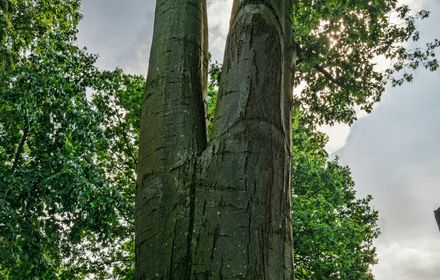
Split and weak forks are two stems with bark pinched between them. In a silver maple, for example, they can break in wind and ice. What we do is check the seam depth and the opening, and then we decide how to treat them.
Hollow and Decaying Trunks
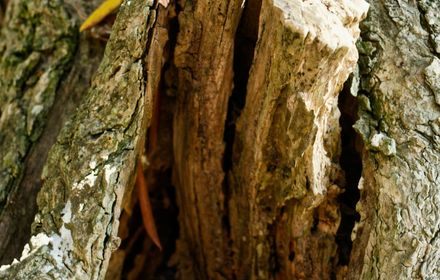
A hollow on its own doesn't condemn a trunk. What decides it is how much sound wood still surrounds the cavity, so we tap the bark for the dull note of rot and slide a probe into any opening. When that still leaves doubt, a Level 3 assessment with decay-testing tools settles it, at extra cost.
Leaning Trees
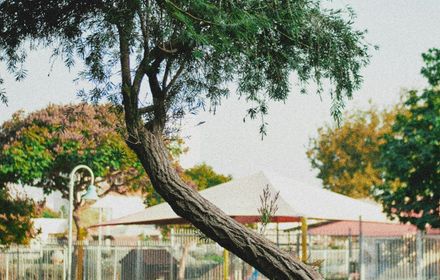
Plenty of trees grow tilted toward the light and stay that way for decades. The usual yardstick for a closer look is a tilt past 15 degrees, or one that changed suddenly. We start on the far side of the lean, where cracks in the soil, or roots heaving up through the lawn, show the anchor giving way.
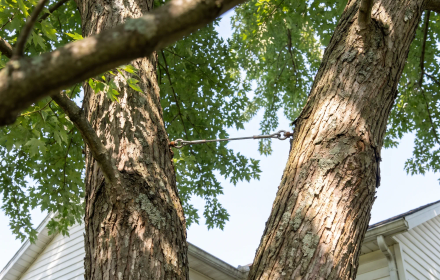
Static Steel Cabling
Steel is the usual fix for a fork that already moves or shows a crack. It is anchored through drilled holes, roughly two-thirds of the distance from the fork to the crown's highest point, where it can hold the stems back with the least pull.
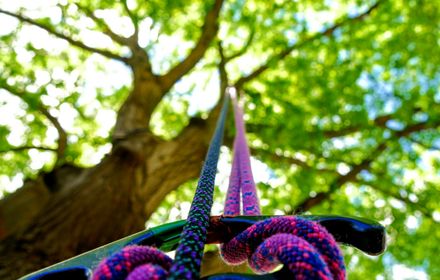
Dynamic Cabling
A dynamic system lets the stems sway and catches them only near the limit, and it goes on without drilling. Think of the chain on a screen door. It hangs slack on a calm day and stops the door before the hinges tear. The catch is upkeep, because TCI Magazine has these checked twice a year.
Other Checks We Do
Trees Over Walks and Streets
A limb hanging low over a walk or street is the first thing we flag, since city code wants 10 feet of clearance there.
Trees Near Power Lines
Inside the city the wires belong to Mishawaka Utilities, which keeps its lines clear and takes reports at (574) 258-1640. The line work is theirs.
Ash Trees and Emerald Ash Borer
We judge whether an ash is worth saving. Spraying or injecting it for hire needs an Indiana pesticide business license, so treatment is left to an applicator who holds one.
Is a Tree Risk Assessment Worth It?
It’s worth it if the tree is tall enough to hit the house or any other property, because it’s going to be cheaper than most removals. But keep in mind that no license is required, so anyone can say “arborist”.
Cable It or Take It Down
A cable earns its cost on a vigorous maple or oak with one weak fork and decades left in it. It is the wrong call on a trunk already cracked below the fork, or one standing on lifting roots.
If it’s not looking dangerous for your car or your house, you could just cable it for a few hundred bucks and have it checked after storms to see that there are no cracks or dangerous limbs. But if it’s in an area where it might fall on someone or something, you would likely cut it down altogether, so you do not risk it.
How a Tree Assessment Is Done
Whose it is
We check whether it stands in your yard, in the city’s curb strip or near a line owned by Mishawaka Utilities. Each one changes who pays and who signs off.
What it could hit
The ISA method rates how likely a part is to fail, how likely it is to strike something, and how bad that strike would be.
A full walk around
This is a Level 2 look under ANSI A300. We scan the canopy through binoculars and tap a mallet up the bark to hear for hollows.
A rating for each defect
Likelihood of failure goes on the ISA scale of improbable, possible, probable or imminent.
Options, ranked
Each tree gets one answer, prune, cable, watch or remove, with a price range and how soon it should happen.
Cabling, if chosen
Steel or dynamic, with the inspection schedule written down so the cable doesn’t get forgotten.
Many Mishawaka subdivisions went up in the 1960s and 1970s, and the city’s median house dates from 1975. Maples planted with those houses are now old enough to reach a roof.
What Do Tree Assessment and Cabling Cost?
| Service | Typical range |
|---|---|
| Risk assessment, one tree | $100 to $250 |
| Consult and report, 1 tree | $150 to $450 |
| Report, several trees | $300 to $700 |
| Cabling, per tree | $200 to $350 |
These are national arborist cost figures (2026). Pruning, removal and Level 3 decay testing are priced separately.
-
How deep the look goes. A walk-by of a row of trees costs least. Aerial inspection and decay testing cost the most, and only heritage or high-value trees usually justify them.
-
How many trees. Several on one visit share the travel and the setup.
-
Steel or dynamic. Dynamic systems skip the drilling but come with checks twice a year, which add up over the life of the cable.
Tree Risk Assessment and Cabling in nearby areas
Get a quote on your tree risk assessment and cabling
Give us the street, what kind of tree it is if you know, and what it stands near: the house, a fence, the lines. Expect a callback with a rough range and the things that could change it.
Tree Risk Assessment and Cabling FAQs
What's the difference between an arborist and a tree service?
An arborist is a person trained in trees, while a tree company is a business, and its crew may vary. Indiana licenses neither of them, and ISA certification is voluntary.
Can a cabled tree still fall over?
Yes, it still can, but the chances are lower than if it's not cabled. A cable limits how far the stems spread, and if there is rot or a crack below, a cable will not help, and the tree needs other treatment, including cutting it down altogether.
Will the City of Mishawaka look at my tree for free?
Code 66-53, on dead trees menacing safety, is what governs this, if you want to take a look. But generally, if it's a curb strip tree, the city might inspect it, and the permit is free. But if it's your yard tree, it's yours to judge, and the city would not help with that.
My neighbor's tree hangs over my house. What can I do?
There is no Indiana statute on it specifically, so you should talk with your neighbor about it. If you cut to the line, it would be at your cost, and if a sick tree is ignored, the owner would be liable for the damage.
Does homeowners insurance pay for an assessment or a cable?
It's rarely paid, because prevention is seldom covered. What usually gets paid for is falling wood damaging a building, but the report still shows that a known problem was handled.
How often should a cable be checked?
If it's a dynamic cable, twice a year is enough. If it's steel, then only after a bad storm, but the fork itself should be checked alongside the cable.
Is hiring an arborist worth it for one tree?
It mostly depends on the tree itself. For a big maple near the roof, yes, we would say it's worth it. For a 15-foot crabapple mid-lawn, which would not hit anything even in the worst case, generally no. A look costs a fraction of a wrong removal.
Request a quote
Call (574) 227-6183 for the quickest answer, or tell us about the tree here and we will phone you.